Whether your workspace is a corner of the living room, a spare bedroom or a converted garden shed, the chair you sit on matters more than almost any other piece of furniture in it. You may spend many hours a day in it, and a poor chair quickly shows up as a stiff back, tight shoulders or restless legs. A good one makes a small space feel like a proper place to work. Here is what to look for.
Start with adjustability
No single chair fits everyone, so the most important feature is the ability to adjust it to your body and your desk. Look for:
- Seat height. You should be able to sit with your feet flat on the floor and your thighs roughly level, with your knees at about the same height as your hips.
- Seat depth. Sit right back in the chair. There should be a small gap, roughly the width of a few fingers, between the front edge of the seat and the backs of your knees.
- Backrest angle and tension. A backrest that tilts and locks lets you sit upright while typing and lean back slightly during calls or reading.
- Lumbar support. A curve or adjustable pad that fits into the small of your back helps you keep a natural posture without effort.
- Armrests. Height adjustable armrests let your shoulders relax. If they cannot be lowered enough to slide under the desk, they can push you too far away from your work.
Materials and comfort
The materials affect both comfort and how the chair fits into the room.
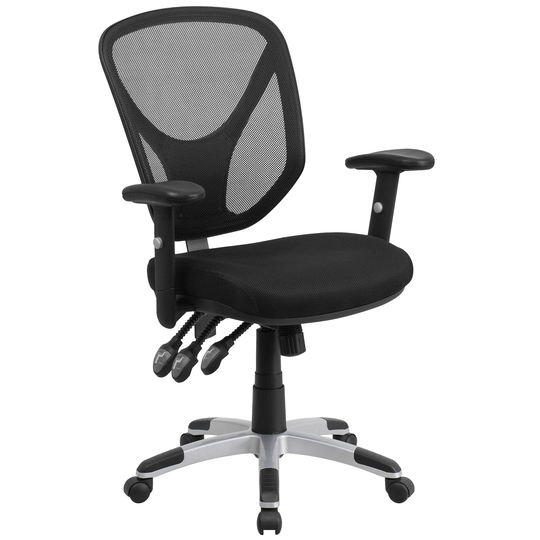
Mesh backs let air circulate, which many people find more comfortable over long periods, especially in a small room that warms up quickly. A chair such as this mid-back mesh office chair is one example of the style.
Upholstered seats in fabric feel soft and look more like living room furniture, which can help a home office blend in with the rest of the house.
Leather and faux leather are easy to wipe clean and look smart, but can feel warm in summer.
Pay attention to the seat cushion too. It should be firm enough to support you through the day rather than sinking flat after an hour.
Fitting the chair to your space
In a compact room or shed, size matters. Measure the space before you buy, and check:
- The overall width, especially with armrests, so the chair fits under or beside the desk.
- The height of your desk, since a chair that sits too low or too high will never feel right.
- The floor. Wheels suited to hard floors or carpet move more easily and are kinder to the surface, and a chair mat can protect wooden floors.
- How the chair looks. In a room you also use for relaxing, a chair in a colour or finish that matches the rest of your furniture keeps the space feeling calm.
You can compare designs and sizes in the office chair range.
Set it up properly
Even an excellent chair needs a little setup. Adjust the seat height first, then the backrest and lumbar support, then the armrests. Position your screen roughly at arm’s length with the top of the screen at or slightly below eye level, and keep the keyboard close enough that your elbows stay near your sides. A footrest can help if your feet do not reach the floor comfortably.
Finally, remember that no chair replaces movement. Stand up, stretch and walk around regularly. If you have ongoing back, neck or joint pain, it is worth speaking to a doctor or physiotherapist about the setup that suits you. Thoughtful interior design and the right furniture make it far easier to work comfortably at home.